Inside this tiny building I am on a journey by Barney Wilczak
The old greenhouse is sunk deep in the soil. It’s once glass roof now a layer of moss covered cedar. Light seeps weakly through a natural stained glass of peony, iris, mint and echium leaves, pressed against the windows. A blackbird calls from the ivy that hangs heavy from the old apple tree above.
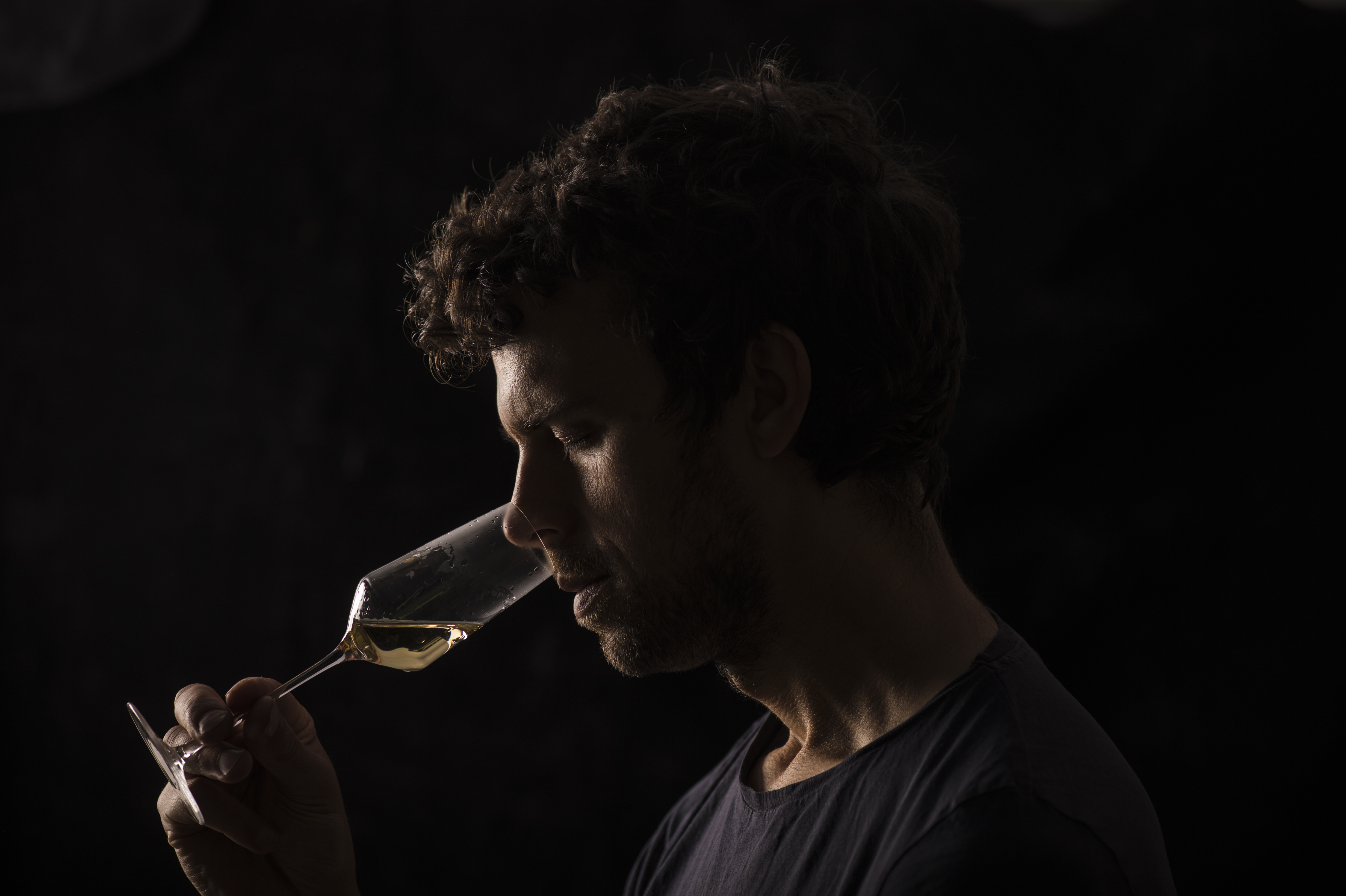
And yet inside this tiny building I am on a journey. A hairline of silver spirit is running from the still. With each drop tasted from my fingers a new aspect of the apples that I am distilling today is revealed. The strange thing is that what I am tasting never tastes like the whole fruit. The liquid in our small still is the pure essence of 2.5 tons of apples and as I watch for nine hours every flavour is coming over sequentially. It is as if being tied to a live feed from a gas chromatograph that, rather than a stream of cold data, bombards me with a succession of synaesthetic and deeply emotive flavours and aromas that reveal as much about plant, climate and locale, as they do fruit.

Through sheer concentration, we find the perfume of Springs blossom preserved within each apple. The physical grain of flesh drawn across our palate. Suddenly beeswax oscillates with juice, nectarine, fresh spring growth and sun warmed bark. As the day progresses we are drawn to the roots of the trees, almond, decay, autumnal leaves and the very earth of the orchard. We simply have no understanding of the complexity of these plants; our job here is to be in reverence. It is no wonder I describe this heavily patinaed building as my church.
The result of the amalgamation of all of these elements is an Eau de Vie, a water of life, that extends the boundaries of flavour and aromas beyond what we would recognise in a single fruit. The superb sommelier, Paz Levinson, describes our work as “drinkable perfumes”, and with the essence of over 60 kg of fruit in each litre of some of our Eau de Vie, I see more connection to the perfumiers of Grasse than the yield driven nature of most distillation.
The truth was I never believed anybody would buy English Eaux de Vie (we launched with a very complex gin, Garden Swift), those bottles were just for me. In reflection this lack of belief in any sense of commerciality was the most freeing thing I could have asked for. Working for your own enjoyment and discipline allows a purely qualitative approach. The smaller our yields became (of alcohol kept) an inverse increase in complexity and nuance reciprocated. They became completely removed from the fiery and musty experiences that often characterise fruit spirits. 10 years on I am still making them for myself.
And so we work with small family farms, within 35 miles of the distillery. Fruit arrives at the absolute moment of ripeness in a harvest that, in 2025, extended to 141 days. Every single berry, pear, plum and quince, is checked individually by hand and cleaned. Every flawed element is removed. This detail affords us the ability to work completely without any additions. Wild fermentations are resilient, adaptive to each season and can extend in excess of five months.
As fermentation comes towards it’s end we distil. The first distillation from the fruit concentrates essence and alcohol into a liquid called low wines. These are further concentrated through being distilled a second time. And then comes the “spirit run”

Our fruit still is only 180 litres. And yet, on that final distillation, it can contain the essence of 3,000kg raspberries. That’s over 560,000 berries, every single one touched and cleaned by hand. And yet, to my palate, we can ruin this all in 20 seconds. The “heads” are fiery. The “hearts” all beauty and life, the ethereal epitome of fruit and what we aim to retain. And in seconds we have the “tails”, all flatness, a drain on all the beauty that came before. By touch, taste and smell, I separate at these critical points. What was once 3,000 litres of fermented fruit results in less than 50 litres of liquid at distillation strength, the perfume of more than 60kg in each litre, 12.5 ml representing the ingredient concentration of an entire bottle of well aged whisky…
For me these spirits are the epitome of terroir expression; removed from the masking elements of heads and tails they show every detail, a magnifying glass held up to every single embroidered stitch of climate, landscape and genetics. Vintages are written large.
In 2023 the heightened rose water and mint we see through the concentration of raspberries was supressed by the cool weather. It was dominated by the purest of violets.
The experience of tasting blackcurrant leaves in a gooseberry distillation still amazes me. Aromatics normally below flavour threshold told me of the genetic connection and shared heritage of these two related plants, an insight into millennia of evolution.
Likewise, our blackcurrant, takes me to sliding my hand through perfumed leaves and spiced stems (despite these being completely absent from the distillation), much more than it does the fruit, each element hidden within the fruit but normally imperceptible.
Flavour and aroma can walk us beneath the boughs of 300 year old perry pear trees, to the very cores of damsons, and amongst the fruit laden branches of the orchard where we pick 1,000 different varieties of apples. They are transcendent.
In the Winter of 2023 we took a new step forward. We planted 252 quince trees, all varieties never before grown in the UK, into a beautiful hay meadow. The choice was made for quality and disease resistance; a stacking of cards so that we can work completely organically and without fungicides and pesticides. Their presence is providing the economic security so that the orchid rich meadow beyond can survive as a working reserve. Our hands are now on the soil as much as the fruit. We can’t wait for the results to come.


Comments